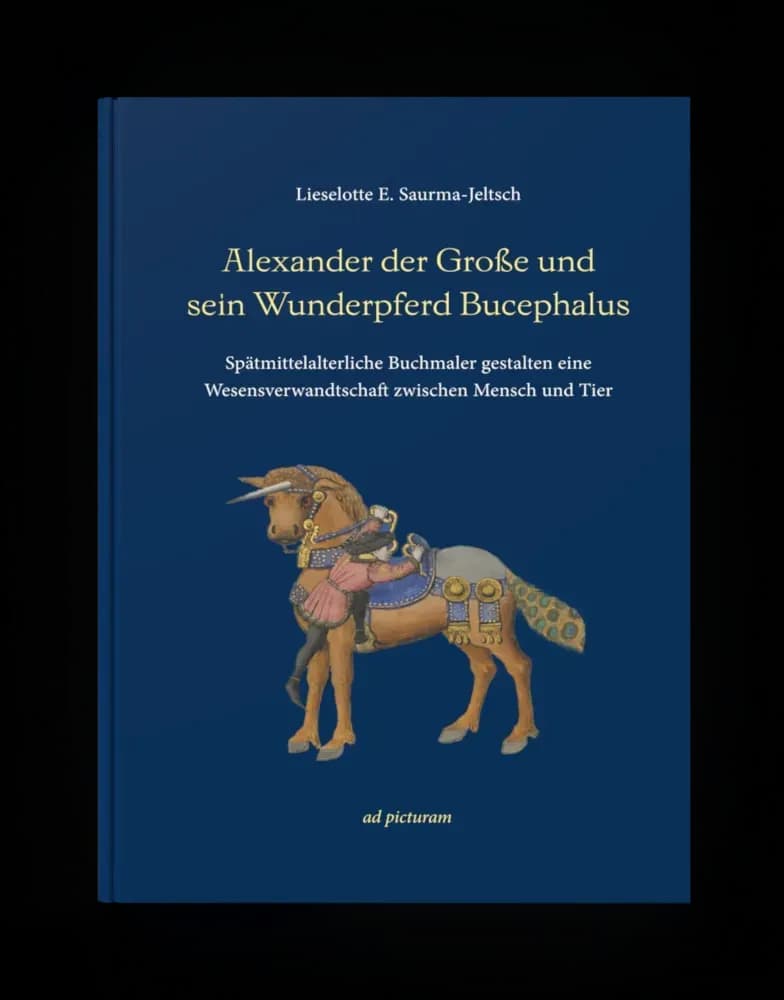
The miracle horse Bucephalus, who talks, foresees events, sheds tears and has incredible strength, victoriously leads Alexander the Great through his successes. In medieval knightly culture, close relationships between horse and rider are a given. However, the essential relationship, the play with boundaries and fusions between humans and animals, as described in the Alexander literature, requires explanation. Particularly in the late medieval illustrations, in which Alexander the Great serves as a role model for the recipient, and often even as an ancestor, this unusual blending of two beings with mysterious origins must be integrated into familiar cultural patterns. With fascinating creativity, the illuminators in early humanistic Augsburg and courtly Paris debate the inexplicable nature of this exceptional couple.
About the author:
Prof. Dr. Lieselotte E. Saurma-Jeltsch is Professor Emeritus of Medieval Art History at the Institute for European Art History at the University of Heidelberg.
The miraculous horse Bucephalus, who speaks, foresees events, sheds tears and possesses incredible power, leads Alexander the Great victoriously through his conquests. In medieval knight culture, close relationships between horse and rider are familiar. However, the affinity, the playing with boundaries and the merging of human and animal, as described in the literature on Alexander, requires explanation. Especially in late medieval illustrations, in which Alexander the Great serves as a role model, and often even as an ancestor, for the recipient, this unusual blending of two beings of mysterious origin must be integrated into known cultural patterns. With fascinating creativity, the illuminators in early humanist Augsburg and courtly Paris debate the inexplicable nature of this exceptional pair.